


How Much EMI Shielding Do Military Electronics Need? Understanding Shielding Effectiveness (dB)
- Home 〉
- FAQ 〉
- Surface Treatment & Coating 〉
- How Much EMI Shielding Do Military Electronics Need? Understanding Shielding Effectiveness (dB)
How Much EMI Shielding Do Military Electronics Need? Understanding Shielding Effectiveness (dB)
There is no single shielding-effectiveness value in dB that applies to every military electronic product.
The required EMI shielding performance depends on the product's operating frequency, electromagnetic environment, enclosure design, apertures and seams, grounding and bonding strategy, cable interfaces, conductive coating system, environmental requirements, and the EMC specification defined by the applicable project or contract.
Table of Contents
- What Is EMI Shielding Effectiveness (dB)?
- How Many dB of EMI Shielding Do Military Electronics Need?
- Does Lower Surface Resistance Mean Better EMI Shielding?
- What Factors Affect Shielding Effectiveness?
- How Should Military EMI Shielding Be Tested?
- What Should Buyers Define Before Requesting an EMI Coating?
- Frequently Asked Questions
- Conclusion
What Is EMI Shielding Effectiveness (dB)?
Shielding effectiveness, commonly expressed in decibels (dB), describes how effectively a material, coating, enclosure, or shielding structure reduces electromagnetic energy from passing through it under defined test conditions.
In general, a higher dB value represents greater attenuation. However, a shielding-effectiveness value is meaningful only when the measurement conditions are also known.
How should a shielding-effectiveness value in dB be interpreted?
A higher shielding-effectiveness value indicates greater electromagnetic attenuation under the stated test conditions. However, 40 dB, 60 dB or 80 dB should not be treated as a universal pass/fail target without also specifying the frequency range, test method and product configuration.
For example, engineers should ask:
- At what frequency or frequency range was the value measured?
- Was the measurement performed on a flat material sample or a complete enclosure?
- What test method and fixture were used?
- Were seams, openings, connectors, cables and grounding included?
- Was the measurement made before or after environmental reliability testing?
Engineering principle: A statement such as "this coating provides 60 dB shielding" is incomplete unless the frequency range, substrate, coating structure and test method are also defined.
How Many dB of EMI Shielding Do Military Electronics Need?
There is no universal answer such as "all military electronics require 60 dB" or "all defense systems require 80 dB." The required shielding level should come from the product specification, EMC control plan, platform requirements, procurement contract, or applicable qualification standard.
Military wearable devices, communication equipment, rugged computers, vehicle electronics, avionics, sensors and other defense-related products can operate in very different electromagnetic environments. Their shielding requirements may therefore differ significantly.
Some engineering teams use internal dB ranges during early design discussions, but these values should be treated only as preliminary design references. They should not replace the actual project-level acceptance requirement.
For B2B buyers: Instead of asking a supplier only, "Can your EMI coating achieve 60 or 80 dB?", provide the required frequency range, test method, enclosure configuration and acceptance criteria. This allows the coating and manufacturing process to be evaluated against the actual application.
Does Lower Surface Resistance Mean Better EMI Shielding?
Not necessarily.
Surface resistance is an important electrical property of a conductive coating, but it does not represent the entire shielding performance of the finished product.
Two coatings with similar surface-resistance values can produce different shielding-effectiveness results when they are applied to different products.
This is because EMI shielding depends not only on conductivity, but also on coating continuity, frequency, geometry, grounding, apertures, seams and the complete electromagnetic design of the enclosure.
Surface resistance is a useful material or process parameter. Shielding effectiveness (SE) in dB is a measured attenuation value under defined test conditions, and its meaning depends on whether the test evaluates a material sample, enclosure, equipment or subsystem.
What Factors Affect EMI Shielding Effectiveness?
A successful EMI shielding design requires multiple factors to work together. Coating conductivity alone cannot compensate for every weakness in an enclosure.
| Design Factor | Why It Matters |
|---|---|
| Conductive material | Material conductivity and coating structure influence electrical performance. |
| Film thickness | Thickness can affect conductivity and attenuation, but increasing thickness does not guarantee proportional improvement. |
| Coating uniformity | Thin areas, discontinuities or poorly coated geometry can create weak points in the shielding path. |
| Frequency range | Shielding behavior varies with frequency, so one dB value should not automatically be applied across all frequencies. |
| Seams and apertures | Openings, ventilation areas, joints and connector locations can become electromagnetic leakage paths. |
| Grounding and bonding | A conductive coating must work with the enclosure's electrical bonding and grounding strategy. |
| Surface preparation | Surface contamination and poor adhesion can affect coating continuity and long-term manufacturing reliability. |
| Environmental exposure | Humidity, corrosion, abrasion and temperature cycling can affect long-term coating performance. |
Related Process Selection Guide
If you are still deciding between conductive paint and vacuum-deposited coating, see EMI Coating vs Conductive Paint: Which Is Better for Military Electronics?
How Should Military EMI Shielding Performance Be Tested?
The appropriate test method depends on what the project is trying to evaluate. Material-level shielding, enclosure-level shielding and equipment-level electromagnetic compatibility are different test objectives.
For military and defense-related electronics, the applicable specification should always be confirmed from the contract, customer requirement or program documentation.
- MIL-STD-461H addresses electromagnetic interference emission and susceptibility requirements for applicable electronic, electrical and electromechanical equipment and subsystems. It should not be interpreted as a specification requiring a particular EMI coating to achieve one universal dB value.
- ASTM D4935-18(2026) provides a method for measuring electromagnetic shielding effectiveness of planar materials under defined far-field conditions.
- IEEE 299 / IEEE 299.1 family provides measurement approaches for electromagnetic shielding enclosures. The applicable method depends on enclosure dimensions and project requirements.
Important: Passing a material shielding test does not automatically mean that the final electronic enclosure or complete subsystem will meet its EMC requirement. Final product performance can also be affected by enclosure geometry, cables, connectors, apertures, bonding and installation conditions.
What Should Buyers Define Before Requesting an EMI Coating?
For international purchasing and engineering teams, defining the performance target before selecting a coating process can significantly reduce repeated trials and unnecessary coating cost.
Useful project information includes:
- Product drawing and enclosure dimensions
- Plastic or substrate material
- Required shielding effectiveness or EMC acceptance requirement
- Required operating and test frequency range
- Grounding and electrical-contact requirements
- Areas requiring masking or electrical continuity
- Environmental and durability requirements
- Required production quantity
- Current manufacturing and secondary-process workflow
- Applicable customer, military or industry test specification
Related Surface Preparation Equipment
For coating processes that require improved substrate cleanliness or surface preparation, SSB also provides plasma cleaning equipment for plastics and metal components.
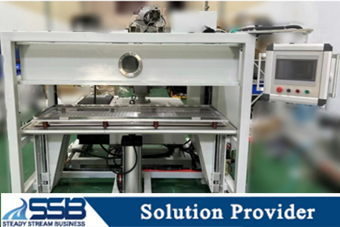
SSB Plasma Cleaning Machine
Plasma cleaning may be used as a surface-preparation step when required by the selected coating process. It does not itself create EMI shielding or determine the final shielding-effectiveness value.
Frequently Asked Questions
Q: How many dB of EMI shielding do military electronics need?
There is no universal dB requirement for every military electronic product. The required shielding effectiveness should be defined according to the applicable program, frequency range, enclosure design, electromagnetic environment, test method and acceptance criteria.
Q: Is 60 dB of shielding enough for military electronics?
It may be sufficient for one application and insufficient for another. A dB value should always be evaluated together with the frequency range, test method, enclosure configuration and project-level EMC requirement.
Q: Does lower surface resistance always provide higher shielding effectiveness?
No. Surface resistance is only one parameter. Finished-product shielding performance also depends on coating continuity, frequency, enclosure geometry, apertures, seams, grounding and electrical bonding.
Q: Does MIL-STD-461H specify a required EMI coating thickness or dB value?
No. MIL-STD-461H addresses EMI emission and susceptibility requirements for applicable equipment and subsystems. It does not prescribe one universal coating thickness or shielding-effectiveness value for every product.
SSB Technical Scope in EMI Shielding and Surface Engineering
Steady Stream Business (SSB) was established in Kaohsiung, Taiwan in 1987 and provides integrated support across mold development, machinery equipment, production planning and automation system integration. Its company qualifications include ISO 9001 and D&B D-U-N-S.
SSB's technical content and solution scope cover vacuum sputtering, vacuum coating, surface treatment and EMI shielding-related applications. For international engineering and purchasing projects, SSB evaluates coating requirements together with substrate, surface preparation, manufacturing conditions, downstream processing and mass-production requirements.
Learn more about SSB's company background and engineering capabilities.
Technical Content by SSB
This article is based on SSB's technical knowledge in plastic injection molding, surface treatment, production equipment and system integration. Actual shielding requirements should always be confirmed according to the customer's EMC specification, frequency range, enclosure design, grounding structure, environmental requirements and applicable validation method.
Related EMI Shielding and Surface Engineering Guides
- EMI Coating vs Conductive Paint: Which Is Better for Military Electronics?
- EMI Coating Technology: Applications of Electromagnetic Shielding Coating in Electronic Components and Military Devices
- Vacuum Metallizing vs. PVD Sputtering Comparison: Surface Coating Guide
Conclusion: Define the Required EMI Performance Before Selecting the Coating
For military and other high-reliability electronics, the correct question is not simply, "How many dB of shielding does this product need?"
The better starting point is to define the required shielding effectiveness across the relevant frequency range, the applicable test method, enclosure configuration, grounding design, environmental conditions and final product-level EMC requirement.
Once these requirements are known, engineers can evaluate coating material, thickness, continuity, surface preparation and manufacturing process based on measurable performance rather than assumptions.
Planning an EMI Shielding or Surface Coating Project?
If your project requires EMI shielding for a plastic enclosure, military electronic device, communication product or other EMC-sensitive component, provide SSB with your product drawing, substrate, frequency range, required shielding performance, environmental conditions and production requirements.
SSB can review the project from surface preparation, coating-process selection and mass-production integration perspectives.


