


Automotive Surface Finishing in 2026: Why Functional Coatings Are Replacing Decorative Plating
As India’s automotive industry accelerates toward electrification and smart vehicle integration, the role of surface finishing is rapidly evolving. In 2026, coatings are no longer valued only for appearance — they are increasingly expected to deliver functional performance that supports electronics, sensors, and next-generation mobility systems.
The Role of Surface Finishing Is Changing
For decades, surface finishing in the automotive industry was closely associated with decorative appearance. Chrome plating and cosmetic coatings were widely used to improve visual appeal and corrosion resistance.
However, the rapid evolution of modern vehicles is fundamentally changing the role of coatings. In 2026, automotive surface finishing is increasingly expected to provide functional value, not just aesthetic benefits.
This shift is also influenced by growing ESG and regulatory pressure from global OEMs. Read more about ESG compliance challenges for suppliers.
Electrification and Smart Vehicles Are Driving New Coating Requirements
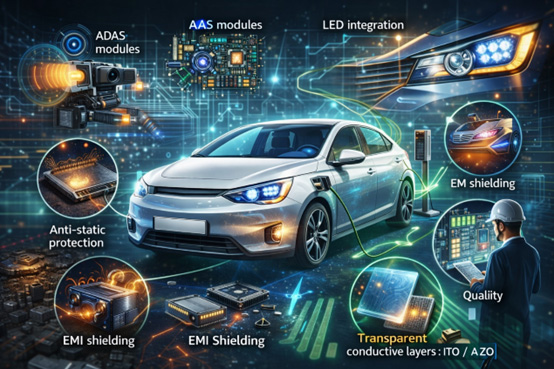
India’s vehicle electrification is accelerating, and modern vehicles are becoming more electronically integrated than ever before.
New automotive applications now include:
- ADAS (Advanced Driver Assistance Systems) modules
- Integrated LED lighting systems
- Sensor-rich electronic assemblies
- Electric vehicle power and control components
These technologies introduce new technical requirements that traditional decorative plating alone cannot address. As a result, coatings must now support electrical, optical, and environmental performance.
Functional Coatings Are Becoming Essential
Modern automotive components increasingly depend on functional surface coatings to ensure stable performance and long-term reliability.
Examples of functional coating applications include:
- Anti-static protection for sensitive electronic modules
- EMI shielding coatings to reduce electromagnetic interference
- UV durability coatings for long-term outdoor stability
- Transparent conductive layers such as ITO and AZO for sensors, displays, and smart surfaces
These coatings are no longer applied simply to improve appearance. They directly contribute to the performance of advanced automotive systems.
Decorative Plating Is Becoming a Smaller Market Segment
Suppliers whose coating capabilities focus only on decorative finishes may find themselves competing in a shrinking segment of the market.
Traditional chrome-look finishes still have applications, but future growth is increasingly concentrated in areas such as:
- Electric vehicle electronics
- Sensor modules
- Smart lighting systems
- Advanced displays and integrated control surfaces
In these applications, coatings that provide functional performance create greater technical value than purely decorative finishes.
Suppliers that continue competing only on low coating price may also face higher long-term operational risk. Learn more about the hidden cost of cheap coating.
Why Functional Coatings Move Suppliers Up the Value Chain
This shift in automotive technology is creating a major opportunity for suppliers.
Rather than competing only on price, companies can move up the value chain by offering advanced coating solutions that solve real engineering challenges.
Technologies gaining greater attention in 2026 include:
- PECVD coating processes
- Conductive thin-film coatings
- EMI surface treatment solutions
- Plasma-assisted functional coating technologies
Suppliers who invest in these capabilities are more likely to become strategic partners in the automotive supply chain, rather than remaining price-driven coating vendors.
Technology Positioning Will Define Competitiveness in 2026
The key question for automotive suppliers is no longer simply whether their coating looks attractive or costs less per part.
The more important question is whether the coating provides measurable functional value.
In 2026, surface finishing is increasingly about technology positioning. Companies must decide whether they want to remain a traditional finishing vendor or evolve into a functional material partner for next-generation vehicle systems.
Conclusion
As electrification, ADAS integration, and sensor-rich vehicle design continue to expand, the future of automotive surface finishing will be defined by function, not decoration.
Suppliers who continue offering only decorative coating solutions may face growing competitive pressure. In contrast, those who develop EMI shielding, conductive layers, anti-static protection, and other advanced coating functions will be better positioned to serve the next generation of automotive manufacturing.
In the evolving automotive market, functional coatings are no longer optional — they are becoming the future of surface finishing.
Frequently Asked Questions (FAQ)
What are functional coatings in automotive manufacturing?
Functional coatings are surface treatments designed to provide performance benefits such as EMI shielding, anti-static protection, UV resistance, and electrical conductivity, rather than only decorative appearance.
Why are decorative coatings becoming less important?
As vehicles become more electronic and sensor-driven, coatings are increasingly required to support technical functions. Decorative finishes still exist, but they represent a smaller share of future growth compared with functional coatings.
What is EMI shielding coating?
EMI shielding coating is a specialized surface treatment that helps block or reduce electromagnetic interference, protecting sensitive automotive electronics and improving system reliability.
Why are ITO and AZO coatings important in modern vehicles?
ITO and AZO are transparent conductive coatings used in sensors, displays, and smart surfaces. They allow components to maintain both conductivity and optical transparency in advanced automotive applications.
Looking for Functional Coating Solutions for Modern Vehicles?
If your company is exploring advanced surface treatment technologies for EV systems, sensor modules, smart lighting, or EMI protection, our team can help you evaluate functional coating solutions aligned with future automotive requirements.
Related Reading
Read more from our Surface Finishing 2026 series:
Automotive Surface Finishing in 2026: ESG Compliance Challenges for Suppliers
Automotive Surface Finishing in 2026: The Hidden Cost of Cheap Coating


