


Automotive Surface Finishing in 2026: The Hidden Cost of Cheap Coating
In the automotive supply chain, many suppliers evaluate surface finishing primarily based on cost per piece. At first glance, a lower coating price appears attractive. However, in reality, the lowest coating price often hides significant operational risks.
As automotive OEMs continue to strengthen quality and sustainability requirements in 2026, the true cost of surface finishing is no longer determined by price alone — stability, repeatability, and process control have become critical factors.
For automotive suppliers, understanding the hidden cost of unstable coating processes is essential for long-term competitiveness.
Why “Low Cost” Coating Can Become Expensive
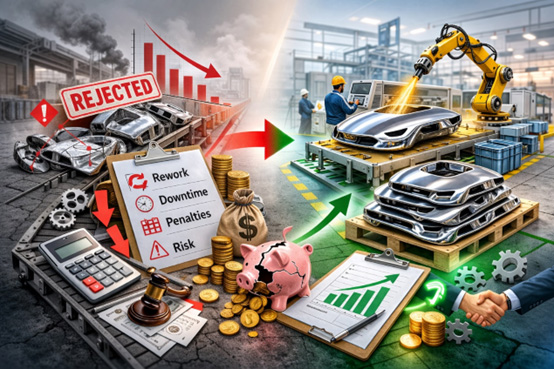
Many suppliers focus on the unit coating cost, but few calculate the total operational impact caused by coating variability.
In practice, unstable coating processes can create multiple hidden costs, including:
- High rejection rates due to inconsistent coating quality
- Additional rework and labor costs
- Production downtime caused by process instability
- Potential environmental penalties from non-compliant chemical processes
- Increased OEM audit risks
When these factors are considered, the apparent “cheap” coating solution may become significantly more expensive than expected.
Automotive OEMs Are Prioritizing Process Stability
In 2026, automotive manufacturers are placing increasing emphasis on process stability and traceability throughout their supply chains.
These rising expectations are also closely tied to broader ESG and compliance demands across the automotive supply chain. Read more about ESG compliance challenges for suppliers.
Different regions emphasize different requirements:
Japanese OEMs prioritize manufacturing stability.
Production processes must deliver consistent and predictable results with minimal variability.
European OEMs emphasize traceability and compliance.
Suppliers must provide clear documentation for process control, environmental compliance, and product quality.
For suppliers, this means surface finishing processes must achieve both reliability and transparency.
Why Yield Rate Matters in Surface Finishing
One key indicator of process stability is yield rate.
In many automotive manufacturing environments, suppliers are expected to maintain a yield rate above 95% with documented repeatability.
If coating processes cannot maintain this level of consistency, suppliers may face:
- Higher scrap rates
- Production inefficiencies
- Increased audit scrutiny
- Reduced confidence from OEM customers
Ultimately, unstable surface finishing processes expose suppliers to long-term operational risks.
How PVD Coating and Process Automation Improve Stability
To address these challenges, many automotive suppliers are turning to automated surface finishing technologies, including Physical Vapor Deposition (PVD) coating processes.
Compared with traditional coating methods, controlled PVD processes offer several advantages:
- Highly stable and repeatable coating quality
- Lower process variability
- Reduced chemical waste and emissions
- Improved environmental compliance
- Better traceability for OEM audits
Automation combined with controlled PVD coating significantly reduces process variation, helping manufacturers maintain consistent production performance.
Beyond stability, advanced coating technologies are also enabling new functional applications in EVs and smart vehicles. Explore how functional coatings are replacing decorative plating.
Lower Variation Means Lower Risk
In automotive manufacturing, process variation directly translates into risk.
Lower variation leads to:
- Higher yield rates
- Reduced rework costs
- Stable production schedules
- Improved supplier reliability
For OEMs, stable suppliers reduce supply chain disruptions and improve product quality.
This is why many automotive manufacturers increasingly value predictability over the lowest price.
The Real Question Suppliers Should Ask
Many suppliers still ask:
“Is PVD coating more expensive than traditional coating methods?”
However, the more important question is:
“What is the cost of process instability?”
When rejection rates, rework costs, downtime, and audit risks are considered, investing in stable surface finishing technologies may ultimately provide a far better return.
Conclusion
As the automotive industry continues evolving in 2026, suppliers must rethink how they evaluate surface finishing technologies.
The lowest price is no longer the most important factor. Instead, process stability, yield rate, and compliance readiness are becoming key determinants of supplier competitiveness.
Automotive suppliers who adopt advanced coating technologies such as PVD and automated surface finishing systems will be better positioned to meet OEM expectations and maintain long-term partnerships.
Frequently Asked Questions (FAQ)
Why is coating stability important in automotive manufacturing?
Coating stability ensures consistent product quality, reduces rejection rates, and helps suppliers meet strict OEM quality standards.
What is PVD coating in automotive surface finishing?
PVD (Physical Vapor Deposition) is an advanced coating technology that provides highly controlled, repeatable surface treatments with reduced environmental impact.
Why do OEMs care about yield rates in surface finishing?
High yield rates indicate stable manufacturing processes, lower defect rates, and reliable supply chain performance.
Looking for Stable and Sustainable Surface Finishing Solutions?
If your company is evaluating more stable, traceable, and environmentally responsible surface finishing technologies for automotive manufacturing, our team can help you explore advanced coating solutions aligned with OEM requirements.
Related Reading
Read more from our Surface Finishing 2026 series:
Automotive Surface Finishing in 2026: ESG Compliance Challenges for Suppliers
Automotive Surface Finishing in 2026: Why Functional Coatings Are Replacing Decorative Plating


