


10 L Plastic Paint Pail Drop Test Guide: Test Orientations, Drop Heights & Injection Mold Design
- Home 〉
- FAQ 〉
- Mold Design & Development 〉
- 10 L Plastic Paint Pail Drop Test Guide: Test Orientations, Drop Heights & Injection Mold Design
10 L Plastic Paint Pail Drop Test Guide: Test Orientations, Drop Heights & Injection Mold Design
For B2B buyers evaluating a 10 L plastic paint pail or paint pail injection mold, a drop test should not be treated as a simple pass-or-fail demonstration.
Drop performance is affected by product design, mold design, wall-thickness distribution, raw material, molding conditions, pail-and-lid fit, closing conditions, filling conditions, and the test method itself. A meaningful validation plan should therefore define the impact orientation, drop height, filled weight, test liquid, temperature, sample quantity, and acceptance criteria before testing begins.
Table of Contents
- What Does the SSB 10 L Paint Pail Drop Test Video Demonstrate?
- Why Is Drop-Test Performance Important for Paint Pail Buyers?
- Which Drop Orientations Should Be Tested for a 10 L Plastic Paint Pail?
- Which Drop Directions Are Particularly Critical?
- How Should the Drop Height Be Determined?
- What Should the Buyer and Supplier Agree on Before Testing?
- Frequently Asked Questions
- Who Is Responsible When a Paint Pail Drop Test Fails?
- Typical Responsibility Matrix for a Plastic Paint Pail Project
- What Should B2B Buyers Provide Before Developing a Paint Pail Injection Mold?
- Why Mold Design Matters to Paint Pail Drop Performance
- Related 10 L Paint Pail Injection Mold Solution
- Related Injection Mold Technical Guides
- Why Work with SSB on a Paint Pail Mold Project?
- Conclusion: A Drop Test Is a System Validation, Not Just a Mold Test
What Does the SSB 10 L Paint Pail Drop Test Video Demonstrate?
The SSB demonstration video presents injection-molded 10 L paint pails subjected to impact on a hard paved surface. The recorded demonstration provides buyers with a visual reference for the structural durability of the pail and lid combination.
For an international purchasing project, however, the more important question is not simply whether a pail survives one impact. A professional drop-test evaluation should also consider which structural area receives the impact and whether the agreed test conditions reflect the actual filling, handling, storage, and transportation environment.
10L Paint Pail Plastic Injection Mold Drop Test by SSB Taiwan
Video published on YouTube: August 18, 2026
Technical note: This video should be regarded as a product durability demonstration. It should not by itself be interpreted as certification or proof of compliance with a specific international packaging standard unless the drop height, filled weight, filling medium, temperature, orientation, sample quantity, procedure, and acceptance criteria have been formally defined and documented.
Why Is Drop-Test Performance Important for Paint Pail Buyers?
For paint manufacturers, packaging companies, plastic pail producers, and distributors, drop resistance directly affects more than the appearance of the container. A failed pail may result in leakage, lid disengagement, deformation, damaged inventory, customer complaints, or logistics losses.
This is why drop performance should be considered during product and mold development rather than only after a mold has entered mass production.
From a procurement perspective, a reliable plastic paint pail injection mold should therefore be evaluated together with:
- Pail wall-thickness distribution
- Bottom and rim structural strength
- Pail opening roundness and dimensional stability
- Lid snap-fit and sealing geometry
- Handle-lug strength
- Raw-material impact performance
- Molding repeatability during mass production
Which Drop Orientations Should Be Tested for a 10 L Plastic Paint Pail?
A plastic paint pail can fail differently depending on where the impact occurs. Evaluating only one drop direction may therefore overlook important structural weaknesses.
| Test Item | Drop Orientation | Primary Verification Focus |
|---|---|---|
| Flat drop on base | Pail upright; entire base lands flat | Base strength, base bulging, and axial buckling of the pail body |
| Flat drop on lid | Pail inverted; entire lid lands flat | Overall lid retention and sealing at the pail opening |
| Diagonal drop on lid rim | Lid rim strikes first at approximately 45 degrees | Snap-fit disengagement, lid peel-off, and ovalization of the pail opening |
| Diagonal drop on bottom rim | Outer bottom rim strikes first at approximately 45 degrees | Bottom-corner cracking and buckling of the lower pail wall |
| Flat drop on side | Pail horizontal with the most protruding edge facing downward | Body denting, liquid impact, and deformation transmitted to the lid |
| Drop near handle lug | Handle lug or attachment point positioned near impact | Handle-lug cracking and localized deformation of the pail opening |
| Drop on structural weak point | Known weak area oriented toward the impact surface | Mold parting lines, localized thin-wall areas, and snap-fit weak points |
Which Drop Directions Are Particularly Critical?
For plastic pails without a separate sealing gasket, several impact directions deserve particular attention because they can directly affect the pail opening and lid retention:
- Diagonal drop on the lid rim
- Side drop on the most protruding edge of the pail body
- Drop with the lid facing downward
- Diagonal drop on the bottom rim
A flat side drop may also be used as a more stringent internal validation method. This does not mean that every international standard specifies a flat side drop as the sole mandatory orientation.
How Should the Drop Height Be Determined?
For non-dangerous-goods plastic paint pails, the appropriate drop height should be agreed according to the actual handling, customer, and logistics requirements of the project.
The following values can be used as practical internal testing references:
| Test Level | Typical Height | Intended Purpose |
|---|---|---|
| Basic test | 0.8 m | General manual-handling risks |
| Routine quality acceptance | 1.0 m | Internal acceptance by pail manufacturers and filling plants |
| Enhanced validation | 1.2 m | Export shipments, customer requirements, or more demanding logistics conditions |
| Limit test | 1.5 m or higher | Determination of the product's practical failure limit |
Important: These heights are common internal testing references rather than one universal statutory requirement for every plastic paint pail. The actual test requirement should be confirmed according to the product, customer specification, shipping conditions, and applicable market requirements.
What Should the Buyer and Supplier Agree on Before Testing?
One of the most common causes of disagreement in a drop-test project is that the test conditions and acceptance criteria were not clearly defined before mold development or sampling.
For a B2B paint pail project, the following information should be agreed in writing before formal validation:
- Drop height: exact validation height
- Filled weight: total test weight of the pail and contents
- Filling liquid: water, simulated liquid, paint, or another agreed medium
- Test temperature: particularly relevant to changing storage or transportation conditions
- Drop orientation: base, lid, side, rim, handle lug, or structural weak point
- Sample quantity: number of samples allocated to each orientation
- Acceptance criteria: leakage, cracking, lid disengagement, deformation, or other project-specific limits
Frequently Asked Questions
Q: What drop orientations should be tested for a 10 L plastic paint pail?
A useful validation plan can include flat drops on the base and lid, diagonal impacts on the lid and bottom rims, a side impact, impact near the handle lug, and testing of known structural weak points.
Q: What drop height should be used for a plastic paint pail?
For non-dangerous-goods pails, internal testing may use approximately 0.8 m for basic handling evaluation, 1.0 m for routine acceptance, 1.2 m for enhanced validation, and 1.5 m or higher for limit testing. The actual requirement should be agreed between buyer and supplier for the specific project.
Q: Does a failed drop test mean the injection mold is defective?
Not necessarily. Drop performance depends on product design, mold design, raw material, molding conditions, pail-and-lid fit, closing conditions, filling conditions, and the test procedure.
Q: What information should a buyer provide for a paint pail injection mold project?
Useful information includes 2D and 3D drawings, a physical sample when available, plastic material specifications, molding machine information, production target, and required sealing, stacking, and drop-test conditions.
Who Is Responsible When a Paint Pail Drop Test Fails?
A drop-test failure should not automatically be assigned to the mold manufacturer, molding plant, or any single supplier.
Drop-test performance = mold design + product design + raw material + molding conditions + pail/lid fit + closing conditions + filling conditions + test conditions
A pail produced from a correctly manufactured mold can still fail if the production part is underweight, the resin grade has insufficient impact strength, the lid is not fully closed, the pail is overfilled, or the test is performed under inconsistent conditions.
Typical Responsibility Matrix for a Plastic Paint Pail Project
| Party | Primary Responsibility | Typical Issues |
|---|---|---|
| Product designer / brand owner | Capacity, weight, material, drop-test requirements, and conditions of use | Incomplete specifications, late changes, or insufficient design safety factor |
| Mold designer / manufacturer | Mold construction, specified dimensions, cooling, gate design, and wall-thickness capability | Dimensional deviation, eccentricity, localized thin walls, or demolding deformation |
| Plastic molding plant | Raw materials, molding parameters, machine settings, cooling, and mass-production quality | Underweight parts, shrinkage, warpage, embrittlement, or unstable batch quality |
| Lid supplier | Lid dimensions, snap-fit features, sealing ribs, and material | Insufficient snap engagement, lid deformation, or unstable dimensions |
| Packaging / paint filling plant | Fill quantity, closing equipment, and storage conditions | Overfilling, incomplete closing, or off-center lid pressing |
| Raw-material supplier | Material properties and batch-to-batch consistency | Insufficient impact strength, incorrect resin grade, or abnormal material quality |
| Testing party | Equipment, procedure, records, and acceptance decision | Incorrect height or orientation, manual throwing, or inconsistent sample conditions |
| Transport / warehousing party | Handling, stacking, temperature, and actual use conditions | Drops beyond agreed height, low-temperature impact, or improper stacking |
What Should B2B Buyers Provide Before Developing a Paint Pail Injection Mold?
A successful paint pail mold project starts before steel cutting. The more clearly the product and production requirements are defined, the easier it is to optimize mold construction and reduce later modification risk.
For an overseas purchasing project, useful information includes:
- 2D and 3D product drawings
- Physical reference sample, when available
- Required pail capacity and filled weight
- Plastic resin and material specification sheet
- Required mold cavity configuration
- Hot-runner or cold-runner preference
- Existing injection molding machine tonnage and specifications
- Monthly or annual production target
- Leakage, sealing, stacking, and drop-test acceptance requirements
Why Mold Design Matters to Paint Pail Drop Performance
For a 10 L plastic paint pail, drop performance starts with the relationship between product design and mold capability.
Important development areas include:
- Uniform wall-thickness control
- Strength around the pail bottom and lower corner
- Roundness and dimensional stability of the pail opening
- Handle-lug structure
- Gate location and filling balance
- Cooling design and shrinkage control
- Pail-and-lid dimensional matching
For packaging applications, these factors influence not only drop resistance but also leakage control, sealing reliability, cycle stability, and mass-production consistency.
Related 10 L Paint Pail Injection Mold Solution
For buyers planning a 10 L paint pail production project, SSB provides dedicated mold development covering product structure, mold design, injection molding requirements, and mass-production planning.
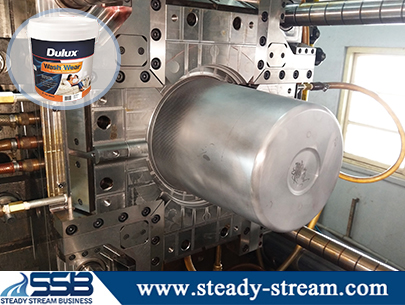
Dulux 10 Liters Paint Pail Plastic Injection Mold
Related Injection Mold Technical Guides
- How Does Injection Mold Cooling Affect Product Quality?
- How Good Mold Structure Design Can Extend the Life of Plastic Injection Molds?
- What Are the Types of Plastic Injection Molds Used in Manufacturing?
Why Work with SSB on a Paint Pail Mold Project?
SSB was established in Kaohsiung, Taiwan in 1987 and provides integrated services for plastic injection mold development, injection molding machinery, production planning, and automation system integration.
For packaging mold projects, SSB supports customers from product and mold design review through production criteria and mass-production planning. The objective is not only to manufacture a mold, but to help the buyer establish a repeatable production solution according to agreed quality requirements.
SSB combines mold-development experience with a system-integration perspective, allowing overseas buyers to review product structure, mold construction, material requirements, injection molding machine conditions, and validation requirements within the same project.
For international purchasing teams: A paint pail mold should not be evaluated only by mold price. Product design, mold structure, resin, molding conditions, pail-and-lid fit, cycle requirements, and drop-test acceptance criteria should be reviewed together before mass production.
Conclusion: A Drop Test Is a System Validation, Not Just a Mold Test
For a 10 L plastic paint pail, reliable drop performance cannot be created by the mold alone. It depends on the interaction between product design, mold design, raw material, molding conditions, lid fit, closing conditions, filling conditions, and the actual test procedure.
For B2B buyers, the most effective approach is to define the required test conditions and acceptance criteria before mold development, then validate the pail under repeatable and documented conditions.
This allows the buyer, mold supplier, molding plant, lid supplier, filling plant, and testing party to work toward the same performance target and helps reduce disputes, mold modifications, and production risk after mass production begins.
Planning a 10 L Plastic Paint Pail Mold Project?
If you are sourcing a 10 L paint pail injection mold for export packaging or mass production, send SSB your product drawing or sample, resin specification, injection molding machine information, target production volume, and required drop-test conditions.
SSB can review the project from product structure, mold design, molding conditions, pail-and-lid matching, production capacity, and mass-production planning perspectives before mold development begins.


 Plastic injection Mold(1).jpg)
 Plastic injection Mold.jpg)


